
Are you dreaming of studying in South Korea for free? Applications for the Global Korea Scholarship 2027 (GKS-U) are officially opening. Funded directly by the Korean Ministry of Education through the National Institute for International Education (NIIED), the GKS program covers 100% tuition, monthly stipends, round-trip flights, and Korean language education.
Whether you want to enter top-tier universities in Seoul or specialized engineering institutions across the country, this guide walks you through everything from eligibility and benefits to document authentication and zero-to-end application steps.
Quick Snapshot: GKS Scholarship 2027 Overview
| Detail | Specifications |
| Host Country | South Korea |
| Funding Agency | NIIED (Ministry of Education, Republic of Korea) |
| Degree Levels | Bachelor’s Degree (4–6 Years + 1 Year Language) / Associate Degree (2–3 Years + 1 Year Language) |
| Total Seats | 286 Scholars Worldwide (156 Embassy Track / 130 University Track) |
| Financial Coverage | Fully Funded (Flights, Tuition, Allowance, Insurance, Settlement, Grants) |
| Age Limit | Under 25 years old (Must be born after March 1, 2002) |
| Primary Portal | Study in Korea Official Website |
Scholarship Benefits: What Does GKS 2027 Cover?
The GKS scholarship is recognized as one of the most generous educational grants in the world:
- Full Tuition Fees: NIIED covers up to KRW 5,000,000 per semester; any excess amount and entrance fees are waived by host universities.
- Round-Trip Airfare: Economy-class flight tickets provided at entry and upon graduation.
- Korean Language Training: 1 full year of intensive Korean training covered up to KRW 5.2 million/year (Exempted if you already hold TOPIK Level 5 or 6).
- Monthly Living Allowance:
- During Language Program: KRW 13,560,000 / year (~KRW 1,130,000 / month)
- During Degree Program: KRW 14,400,000 / year (~KRW 1,200,000 / month)
- Settlement Allowance: A one-off cash disbursement upon arrival in Korea.
- National Health Insurance: Medical coverage throughout the scholarship tenure.
- Proficiency & Completion Grants: Cash incentives for obtaining TOPIK 5/6 and a graduation support grant upon completion.
Quota & Tracks: Embassy Track vs. University Track
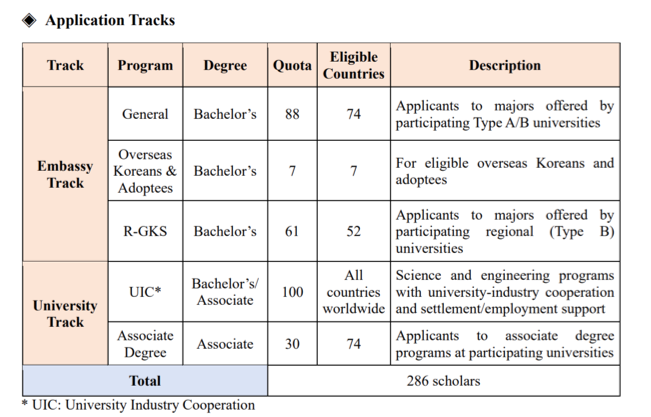
A total of 286 international students will be selected under the 2027 undergraduate program across two distinct tracks:
Source: https://gksscholarship.com/gks-scholarship-2027-global-korea-scholarship-2027-apply-now/
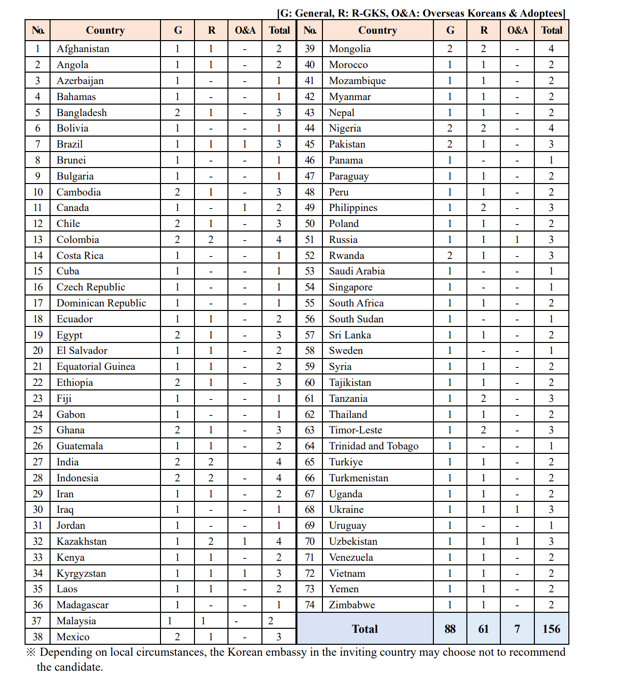
1. Embassy Track (156 Seats across 74 Countries)
- General Program: 88 scholars
- Regional Universities (R-GKS): 61 scholars
- Overseas Koreans & Adoptees: 7 scholars
- Application Rule: You can select up to 3 universities (at least one must be a regional Type B institution).
For example, the official Global Korea Scholarship 2027 quota includes 3 Embassy Track positions for Pakistan, 4 for India, 3 for Bangladesh, 4 for Indonesia, 3 for the Philippines and varying quotas for other participating countries.
Source: https://gksscholarship.com/gks-scholarship-2027-global-korea-scholarship-2027-apply-now/
2. University Track (130 Seats)
- University Industry Cooperation (UIC) Program: 100 scholars (Open to all partner countries, heavily focused on STEM, Big Data, AI, Bio-tech, and Robotics).
- Associate Degree Program: 30 scholars.
- Application Rule: You can apply to only 1 university and 1 department.
Eligibility Criteria for GKS 2027
To avoid immediate disqualification, ensure you satisfy all four requirements:
- Nationality:
- You and both parents must hold citizenship of an eligible partner country.
- Neither you nor your parents can hold dual Korean citizenship.
- Age:
- Must be under 25 years of age (born after March 1, 2002).
- Academic Background:
- High school graduates or those expected to graduate by December 31, 2026.
- Note: If you already hold a 4-year bachelor’s degree, you are ineligible for GKS-U.
- Academic Performance (GPA):
- Must score 80% or higher on a 100-point conversion scale, OR rank in the top 20% of your class, OR meet the minimum CGPA requirement:
- 4.0 Scale: Min. 2.64
- 4.3 Scale: Min. 2.80
- 4.5 Scale: Min. 2.91
- 5.0 Scale: Min. 3.23
- Must score 80% or higher on a 100-point conversion scale, OR rank in the top 20% of your class, OR meet the minimum CGPA requirement:
Required Documents Checklist
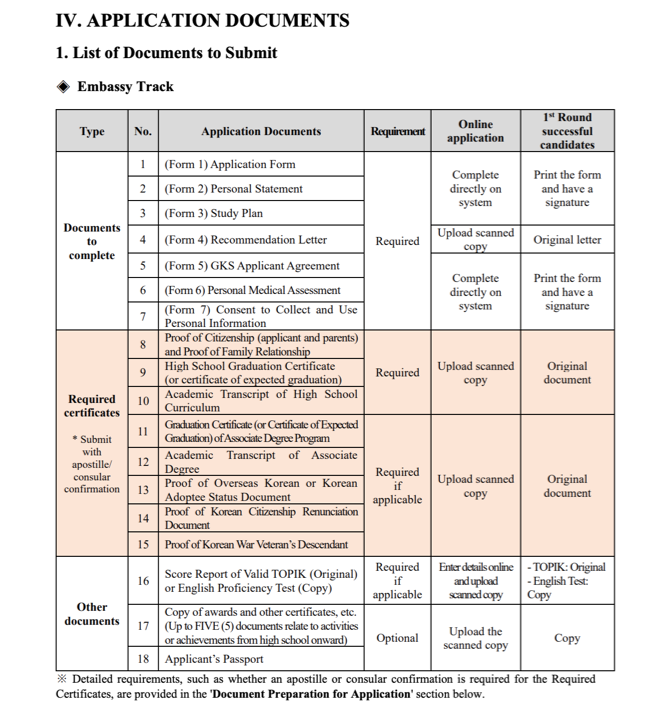
Organize your documents according to NIIED’s required ordering format:
Part 1: Official Application Forms
- [Form 1] Application Form
- [Form 2] Personal Statement
- [Form 3] Study Plan (Language study goals + Degree study goals)
- [Form 4] One Recommendation Letter (from a teacher, principal, or academic mentor)
- [Form 5] GKS Applicant Agreement
- [Form 6] Personal Medical Assessment
- [Form 7] Consent to Collect and Use Personal Information
Required Documents (Embassy Track)
Source: https://gksscholarship.com/gks-scholarship-2027-global-korea-scholarship-2027-apply-now/
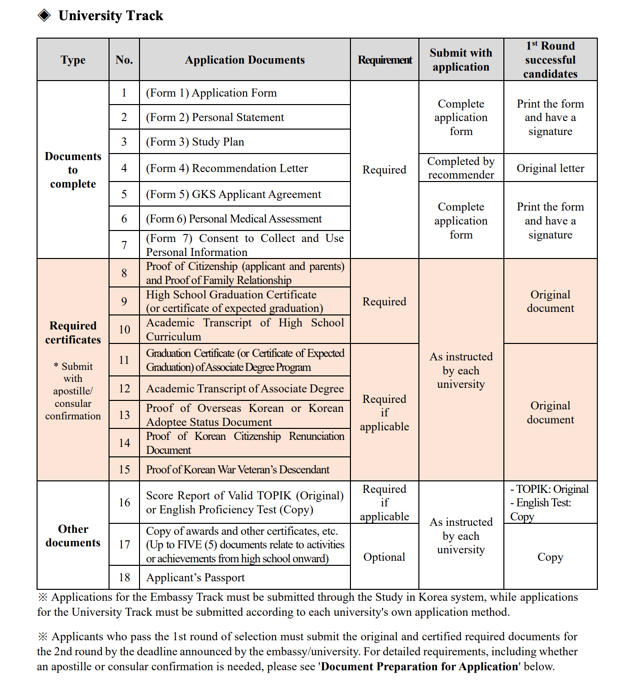
Required Documents (University Track)
Source: https://gksscholarship.com/gks-scholarship-2027-global-korea-scholarship-2027-apply-now/
Part 2: Mandatory Certificates (Apostilled or Consular Confirmed)
- Proof of applicant and parents’ citizenship (Passport copies, National IDs, Birth Certificate showing parental relations).
- High school graduation certificate (or expected graduation letter).
- Official academic transcripts from all years of high school.
Part 3: Optional Supporting Documents
- Valid TOPIK or TOEFL / IELTS score reports.
- Up to 5 certificates of awards, publications, or extracurricular achievements.
Crucial Rule on Legalization: Certificates written in languages other than English or Korean must be accompanied by a certified translation. All certificates must receive an Apostille or Consular Legalization from the Korean Embassy. Plain photocopies are rejected.
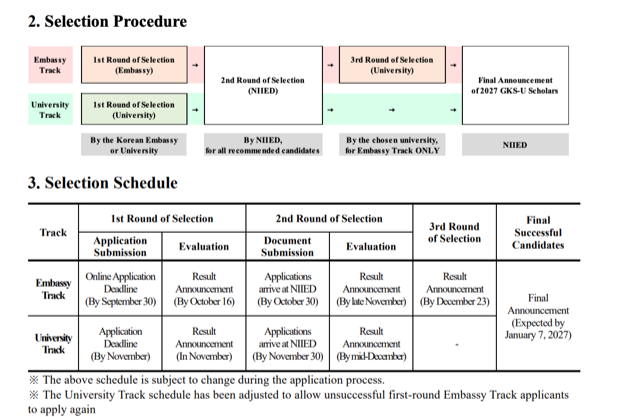
Selection Procedure
How to Apply: Step-by-Step (0 to End)
Follow this end-to-end timeline depending on the path you choose:
Phase 1: Track Decision & Program Research
- Download the official NIIED Guidelines & University Information file.
- Review available majors across Type A (e.g., Seoul National University, Yonsei, Korea University) and Type B regional institutions.
- Choose between Embassy Track (3 university choices) or University Track / UIC (1 university choice, direct focus on STEM & industry alignment).
Phase 2: Document Compilation & Legalization
- Draft your Personal Statement and Study Plan highlighting your academic readiness, purpose, and post-study career goals.
- Request a formal recommendation letter in a signed, sealed envelope.
- Send your high school diploma, transcripts, and family relation documents for Ministry of Foreign Affairs / Apostille verification.
Phase 3: Submission
- For Embassy Track Applicants:
- Create an account on the official Study in Korea website.
- Complete your online profile and upload digital copies during the submission window (September 15 – September 30, 2026).
- If shortlisted in Round 1, courier your physical apostilled documents to the Embassy.
- For University Track Applicants:
- Submit your physical dossier directly to your chosen Korean university’s international admissions office via international courier (DHL/FedEx) according to their specific deadline (typically September through November).
Phase 4: Selection Rounds & Final Placement
- Round 1 (Embassy / University Level): Document screening and interview.
- Round 2 (NIIED Level): Central evaluation of recommended candidates.
- Round 3 (University Admissions – Embassy Track only): Universities review files and issue unconditional admission letters.
- Visa & Departure: Secure your D-2 / D-4 visa, attend the pre-departure orientation, and fly to Korea in late February to start language school in March!
Expert Tips to Stand Out
- Balance Your University Choices: For Embassy Track, avoid choosing three hyper-competitive “SKY” universities (Seoul National, Korea, Yonsei). Pick at least one strong Type B regional university with high placement rates to secure admission in Round 3.
- Demonstrate Clear Career Ties to Korea: Avoid generic essays. Explain exactly why Korean academic infrastructure, industry partnerships, or research labs suit your future career better than studying anywhere else.
- TOPIK Points: Even a basic TOPIK Level 1 or 2 certificate awards bonus evaluation points in the first screening round.
Frequently Asked Questions (FAQ)
Can I apply for both Embassy Track and University Track at the same time?
No. Applying to both tracks in the same cycle leads to immediate disqualification by NIIED. You must choose one track.
Is Korean language fluency mandatory to apply?
No. GKS provides one full year of intensive Korean language training before your degree starts. However, prior TOPIK scores give applicants a competitive edge.
What happens if I fail to get TOPIK Level 3 after the 1-year language program?
Scholars must attain at least TOPIK Level 3 before commencing their undergraduate degree. Failure to meet language benchmarks may result in an extended language term or cancellation of scholarship status according to NIIED regulations.